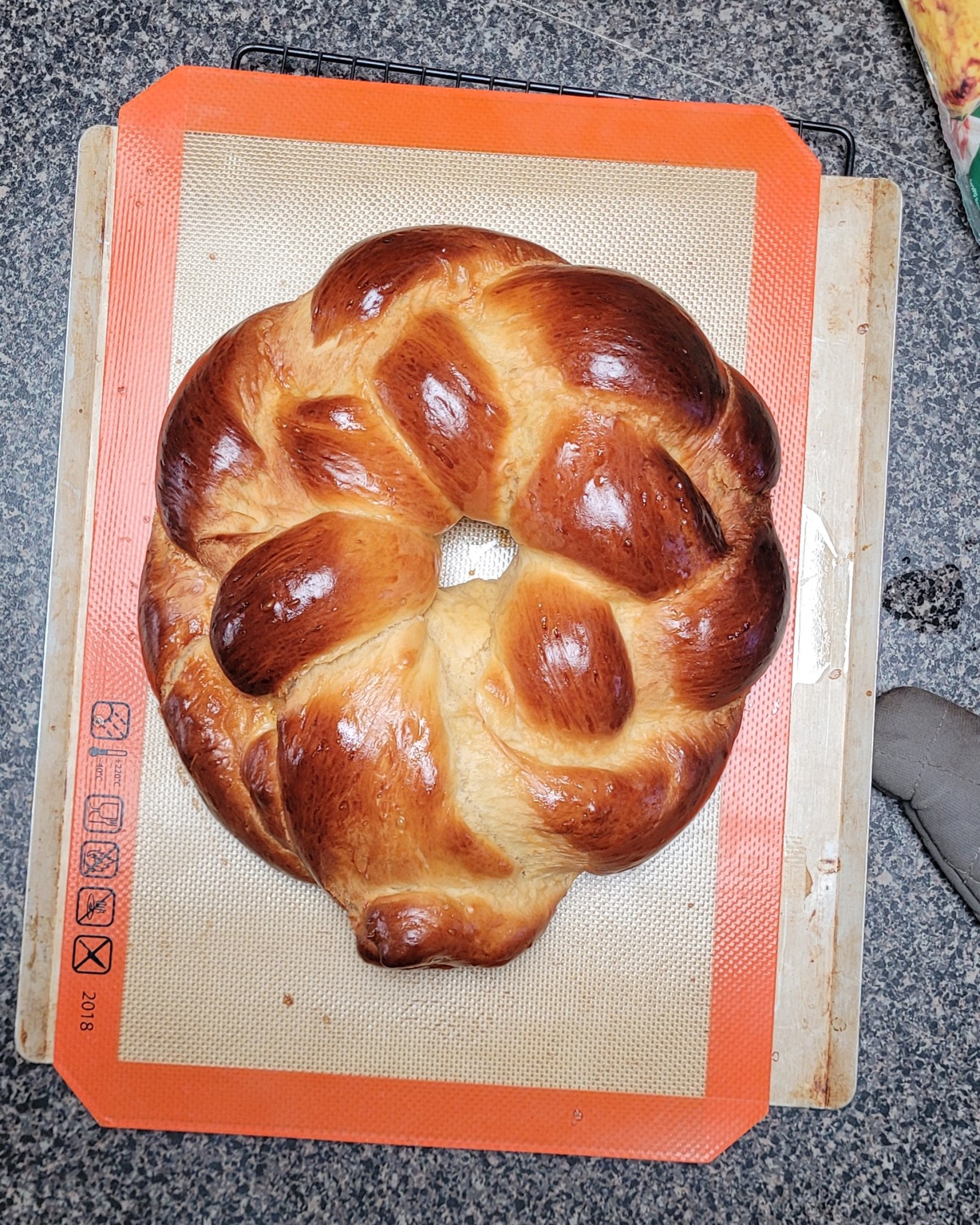
It’s coming up to Easter, and Greek Easter too, which for me means baking this amazing-smelling, super tasty, light and delicious bread.
The recipe is loosely based on a couple I found elsewhere many moons ago, but I have amended the ingredients slightly to improve that orangey spicy smell and deliver a softer and slightly sweeter crumb.
Below is a short TikToK I made of how to make this yummy bread showing a bit of the kneading, how I prove the dough, and the all-important plating. I recommend plating from the middle as this will help if you wish to make into a ring. If kept as a straight loaf it lets you can tidy the ends neatly by tucking under.
Happy Baking !
Ingredients
- 35 g unsalted butter at room temperature (4.7 oz.)
- 135 g milk at room temperature(4.7 oz.)
- 200 g sugar 7 oz.
- 4 medium eggs at room temperature
- 870 g bread flour 30 oz.
- 21 g dry yeast 0.7 oz.
- 100 g lukewarm water 3.5 0z.
- 1 large Orange – zest and juice
- 3 g ground mastic 0.11 oz.
- 4 g ground mahlepi 0.14 oz.
Glaze
- 1 egg
- 1 tbsp water
Method
- Combine the lukewarm water, a pinch of sugar and yeast and stir. Set
aside for about 6-7 minutes, until the yeast rises and starts bubbling - Use a pestle or a blender to ground the masticha and mahlepi, along
with a pinch of sugar and set aside.
These aromatic spices will give Greek Easter bread its distinctive taste
and amazing smell. But be careful not to add any more mastic than
this tsoureki recipe calls for, as it will leave a slightly bitter taste to
your Greek Easter bread. - In a saucepan add the butter, sugar and milk. Place over very low heat
and stir until the butter melts and the sugar dissolved. The key is to
melt the butter at very low heat, so that the temperature doesn’t ‘kill’
the yeast. Remove the pan from the stove and check the temperature.
The mixture should be at the same temperature as your finger. If it is
warmer, leave to cool down for a few minutes and check again. - Pour the butter mixture in a large bowl and whisk in the eggs. Add
the yeast mixture and whisk to combine. - Add the flour, the ground mastic and mahlepi, orange zest and the
butter-egg-yeast mixture from step 4 all into the mixer. Using the
dough hook, mix at first at low speed, until the ingredients start to
combine and then mix at medium-high speed for about 15 minutes,
until the dough doesn’t stick on the sides of the bowl. At this point
the dough should be really soft and a little sticky. (Be careful not to
add any more flour than this tsoureki recipe calls for, as the dough
should be really soft and not firm). - Cover the dough with plastic wrap and place in a warm environment,
until at least it doubles in size (for about 2-3 hours). - Gently deflate the tsoureki dough with your hands and cut in 6 equal
portions (three for each Greek Easter bread). Take one piece of the
dough (do not flour the working surface!) and roll it a little bit with
your hands. Hold with your hands from the edges and shake to
stretch the dough into a rope. This technique will help the Greek
Easter bread (tsoureki) form the characteristic stringy texture, as seen
in the picture. Form the Greek Easter bread into a braid and transfer
on a large baking tray layered with parchment paper. Repeat the
same procedure with the second tsoureki. Let the Greek Easter bread
rise for about 1 more hour at room temperature, until it almost
doubles in size. - For the glaze, combine the egg and 1 tbsp water and whisk with a
fork. Brush the top of each Greek Easter bread with the egg, being careful not to deflate it, - Bake in preheated oven at 160C for about 30-40 minutes, until nicely browned and fluffy.
- Let the Greek Easter bread cool down and wrap well with plastic wrap, so that it doesn’t become hard and dry. Store for up to 5-7 days at room temperature.
Notes
This is a nut free version of the traditional recipe, as we are a nut free home. The classic version has flaked almonds sprinkled on top of the glaze just before putting in the oven.
There are also some very yummy chocolate versions out there which look amazing, and I have seen dried fruit versions too.
 VinceHomeMade